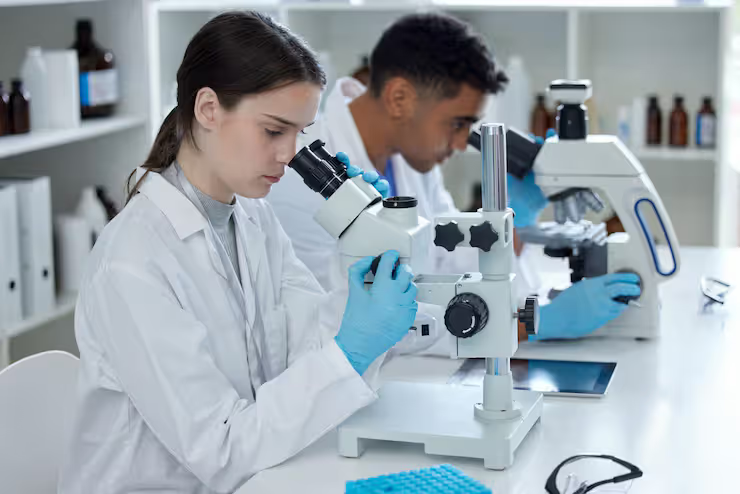
Microscopy is a scientific method used to observe structures and details that are too small to be seen with the naked eye. It exists to help students, educators, and researchers explore the microscopic world, including cells, tissues, microorganisms, materials, and nanostructures. By magnifying objects at high resolution, microscopy bridges the gap between theoretical science and real-world observation.
The development of microscopy techniques has been driven by the need to better understand biological processes, material properties, and chemical interactions at micro and nano scales. Over time, improvements in optics, electronics, and digital imaging have expanded microscopy beyond basic visual observation into precise analytical imaging.
Today, microscopy techniques are widely used in life sciences, materials science, environmental studies, medical research, and industrial quality analysis. Each technique serves a specific purpose, depending on the sample type, resolution requirement, and analytical goal.
Why microscopy techniques matter today
Microscopy plays a crucial role in modern education and research because it allows direct visualization of complex structures that cannot be explained through theory alone. It supports accurate data interpretation and improves experimental reliability.
Students benefit from microscopy by gaining practical exposure to cellular structures, crystallography, and micro-scale behavior. Researchers rely on advanced microscopy imaging to validate hypotheses, detect anomalies, and document scientific findings with precision.
Microscopy techniques help address several key challenges:
-
Identifying cellular changes in biological research
-
Examining material defects and surface properties
-
Supporting diagnostic research and pathology studies
-
Enabling nanotechnology and semiconductor analysis
The following table highlights common microscopy techniques and their typical applications:
| Microscopy Technique | Primary Use Area | Typical Magnification |
|---|---|---|
| Optical Microscopy | Education, basic biology | Up to 1,000× |
| Electron Microscopy | Materials and nanoscience | Over 1,000,000× |
| Fluorescence Microscopy | Cell biology research | High contrast imaging |
| Confocal Microscopy | 3D cellular analysis | Layer-by-layer imaging |
By solving visibility limitations, microscopy continues to support innovation across scientific disciplines.
Recent developments and trends in microscopy
Over the past year, microscopy has seen steady advancements driven by digital integration and automation. In 2024, several research institutions adopted artificial intelligence–assisted image processing to improve accuracy and reduce manual analysis time.
High-resolution microscopy systems have also benefited from improved detector sensitivity and faster image acquisition. These updates allow researchers to capture dynamic biological processes in real time without compromising sample integrity.
Another notable trend since late 2024 is the wider adoption of cryogenic electron microscopy for structural biology studies. This technique enables near-atomic resolution imaging while preserving native molecular structures.
Key trends observed in 2025 include:
-
Increased use of machine learning for microscopy data interpretation
-
Growth in multi-modal microscopy combining optical and electron imaging
-
Expansion of cloud-based microscopy data storage and collaboration
These changes reflect a shift toward more data-driven and collaborative research environments.
Regulatory considerations and research policies in India
In India, microscopy-based research is influenced by academic, safety, and ethical guidelines established by government and institutional bodies. Research laboratories operating microscopy equipment must comply with standards related to laboratory safety, data integrity, and ethical research conduct.
Organizations such as the Department of Biotechnology and the Indian Council of Medical Research provide frameworks that guide microscopy usage in biological and medical studies. These policies emphasize responsible handling of biological samples, proper documentation, and transparent reporting of findings.
For educational institutions, microscopy training is aligned with curriculum standards set by national education authorities. Equipment usage protocols are designed to ensure student safety while maintaining scientific accuracy.
Environmental and radiation safety guidelines also apply to advanced microscopy systems, particularly electron microscopy, where controlled environments and proper shielding are required.
Practical tools and learning resources for microscopy
A wide range of tools and digital resources support microscopy education and research. These resources improve learning efficiency, data accuracy, and reproducibility.
Helpful resources include:
-
Digital microscopy simulation platforms for concept learning
-
Image analysis software for microscopy data processing
-
Online microscopy atlases for biological reference
-
Research databases containing peer-reviewed microscopy studies
The table below outlines commonly used microscopy support tools and their purpose:
| Tool Type | Function |
|---|---|
| Image Analysis Software | Enhances contrast and measurement accuracy |
| Virtual Microscopy Platforms | Supports remote learning and training |
| Data Management Systems | Organizes large microscopy datasets |
| Research Journals | Provides validated microscopy case studies |
These tools help users move beyond observation toward analytical understanding.
Frequently asked questions about microscopy techniques
What is the main difference between optical and electron microscopy?
Optical microscopy uses visible light and lenses, while electron microscopy uses electron beams, allowing much higher resolution imaging.
Can microscopy techniques be used for non-biological samples?
Yes. Microscopy is widely used in materials science, geology, electronics, and environmental research.
Is microscopy difficult for beginners to learn?
Basic microscopy concepts are accessible to beginners, especially with guided instruction and digital learning tools.
Why is sample preparation important in microscopy?
Proper preparation ensures accurate imaging, reduces artifacts, and protects the integrity of the sample.
How has digital technology improved microscopy?
Digital imaging enables faster analysis, easier data sharing, and improved image accuracy through software enhancements.
Concluding perspective on microscopy education and research
Microscopy techniques remain fundamental to scientific exploration and learning. By making invisible structures visible, they enable deeper understanding across biology, chemistry, physics, and materials science.
Ongoing advancements continue to improve imaging accuracy, efficiency, and accessibility. For students, microscopy builds foundational scientific skills. For researchers, it supports discovery, validation, and innovation.
As microscopy evolves alongside digital and analytical technologies, its role in education and research will remain essential, supporting evidence-based science and responsible knowledge development.