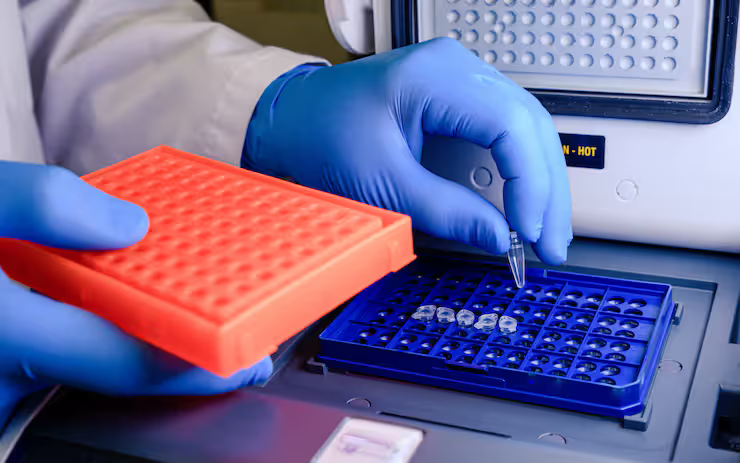
Tumor Necrosis Factor Alpha (TNF-α) is a cytokine involved in the body’s immune and inflammatory responses. It plays a key role in how the immune system reacts to infection, injury, and chronic inflammatory conditions. Measuring TNF-α levels helps researchers and healthcare professionals understand immune activity in different biological settings.
An ELISA (Enzyme-Linked Immunosorbent Assay) is a laboratory method designed to detect and quantify specific proteins in biological samples such as serum, plasma, or cell culture supernatants. TNF Alpha ELISA kits were developed to provide a standardized and reproducible way to measure TNF-α concentrations accurately.
These kits exist because cytokines like TNF-α are often present in very small amounts and cannot be reliably measured using basic laboratory techniques. ELISA technology enables sensitive detection while maintaining consistency across studies and laboratories.
TNF Alpha ELISA kits are widely used in biomedical research, clinical investigations, pharmaceutical development, and immunology studies. Their structured design allows users to follow a defined protocol and obtain quantifiable results suitable for analysis and comparison.
Importance: Why TNF Alpha Measurement Matters Today
Inflammation is central to many health conditions, ranging from autoimmune disorders to metabolic and cardiovascular diseases. TNF-α is one of the most studied inflammatory markers because of its broad biological impact.
Measuring TNF-α levels is important for several reasons:
-
It helps identify inflammatory activity in biological samples
-
It supports research into immune system behavior
-
It aids in monitoring disease progression in inflammatory conditions
-
It assists in evaluating responses in therapeutic research
The topic affects multiple groups, including researchers, laboratory professionals, clinicians, and public health analysts. TNF Alpha ELISA kits help solve the problem of inconsistent or imprecise cytokine measurement by providing a validated analytical method.
In population-level studies, TNF-α data contributes to a better understanding of chronic inflammation trends and immune-related disorders. In controlled laboratory environments, it supports reproducibility and comparability of experimental findings.
Overview Table: TNF Alpha ELISA Characteristics
| Parameter | Description |
|---|---|
| Target Molecule | Tumor Necrosis Factor Alpha |
| Detection Method | Enzyme-Linked Immunosorbent Assay |
| Sample Types | Serum, plasma, cell culture media |
| Sensitivity Range | Picogram per milliliter (pg/mL) |
| Output Format | Quantitative concentration values |
Recent Updates: Trends and Developments in the Past Year
Over the past year, TNF Alpha ELISA methodologies have seen incremental improvements focused on accuracy, reproducibility, and efficiency.
In March 2025, several peer-reviewed studies highlighted enhanced antibody specificity, reducing cross-reactivity with structurally similar cytokines. This trend supports more reliable data interpretation in complex inflammatory profiles.
By July 2025, laboratory best-practice guidelines emphasized improved standard curve validation techniques, ensuring better consistency across repeated assays. These updates reflect a broader movement toward harmonized immunoassay protocols.
Another noticeable trend in late 2025 was increased integration of automated plate readers and digital data analysis software. These tools minimize manual handling errors and support standardized reporting formats.
Overall, recent updates focus less on radical changes and more on refining existing ELISA practices to meet modern research quality expectations.
Laws or Policies Affecting TNF Alpha ELISA Usage
The use of TNF Alpha ELISA kits is influenced by laboratory regulations and research governance policies rather than consumer-level laws.
In many countries, immunoassays used in research and diagnostics must comply with:
-
Good Laboratory Practice (GLP) guidelines
-
Institutional ethical review standards
-
National biomedical research regulations
-
Data integrity and documentation rules
In regions such as the United States, ELISA-based assays used for clinical research must align with regulatory frameworks governed by agencies overseeing laboratory testing quality. In the European Union, similar oversight applies under in vitro diagnostic and laboratory research directives.
These policies ensure that TNF-α data generated from ELISA assays is reliable, reproducible, and ethically obtained. Regulatory compliance also supports transparency in published research and cross-border data comparison.
Tools and Resources Related to TNF Alpha ELISA Analysis
Several tools and resources help support accurate TNF-α measurement and data interpretation.
Commonly used resources include:
-
ELISA data analysis software for curve fitting
-
Microplate readers with absorbance detection
-
Standard curve calculators for cytokine quantification
-
Laboratory information management systems (LIMS)
-
Scientific databases for cytokine reference ranges
Helpful online resources often provide protocol templates, validation guidance, and troubleshooting references. Educational platforms also publish updated best-practice documents for immunoassay handling and interpretation.
Sample Data Representation: TNF Alpha Levels
| Sample Group | Average TNF-α Level (pg/mL) |
|---|---|
| Healthy Control | 5–15 |
| Mild Inflammation | 15–30 |
| Elevated Inflammatory Activity | 30+ |
These values are illustrative and may vary depending on sample type, assay sensitivity, and laboratory conditions.
FAQs: Common Questions About TNF Alpha ELISA Kits
What does a TNF Alpha ELISA measure?
It measures the concentration of Tumor Necrosis Factor Alpha, a cytokine involved in immune and inflammatory responses, in biological samples.
Why is ELISA used instead of other methods?
ELISA provides high sensitivity, specificity, and quantitative results, making it suitable for detecting low-level proteins like cytokines.
Which samples are commonly tested?
Serum, plasma, and cell culture supernatants are the most frequently used sample types.
How accurate are TNF Alpha ELISA results?
Accuracy depends on proper protocol execution, calibrated equipment, and validated antibodies. When handled correctly, results are highly reproducible.
Are TNF Alpha ELISA kits used only in medical research?
No. They are also used in immunology studies, pharmacological research, and biological pathway analysis.
Conclusion
TNF Alpha ELISA kits play a critical role in understanding inflammation and immune system behavior. By providing a standardized and sensitive method for cytokine measurement, they support reliable research outcomes across multiple scientific disciplines.
Their importance continues to grow as inflammation-related conditions receive increased research attention. Recent methodological refinements, regulatory oversight, and improved analytical tools have strengthened their reliability and relevance.
For researchers and professionals seeking accurate inflammatory marker measurement, TNF Alpha ELISA remains a foundational analytical approach grounded in established scientific practice.