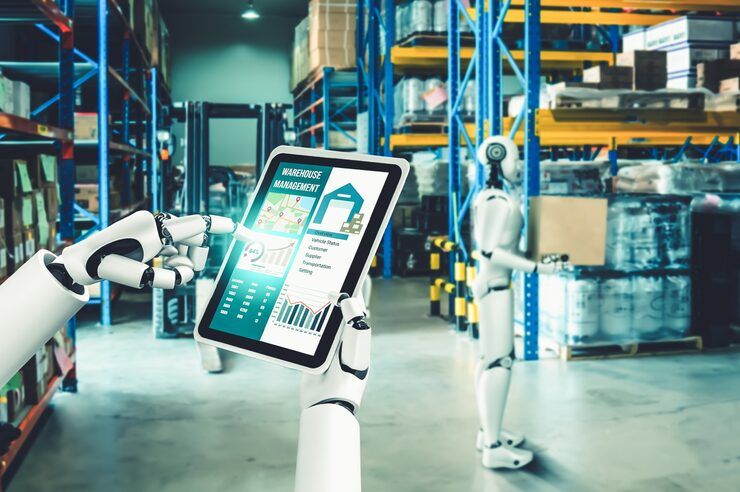
Artificial Intelligence (AI) in manufacturing refers to the use of computer systems that can analyze data, recognize patterns, and support decision-making in industrial environments. These systems rely on technologies such as machine learning, computer vision, and predictive analytics to assist machines and software in performing tasks that previously required human judgment.
Manufacturing environments generate large volumes of data from sensors, machines, production lines, and inspection systems. Traditional software struggles to process this data efficiently or adapt to changing conditions. AI exists in manufacturing to address this limitation by learning from data and continuously improving performance over time.
Initially, AI adoption focused on basic automation and rule-based systems. Over time, advances in computing power, data availability, and algorithms enabled more intelligent applications. Today, AI supports activities such as production monitoring, defect detection, equipment diagnostics, and process optimization across many industrial sectors.
Importance: Why AI in Manufacturing Matters Today
AI plays a significant role in modern manufacturing due to increasing production complexity, global competition, and the demand for consistent quality. Manufacturers are under pressure to improve efficiency while minimizing waste, downtime, and operational errors.
This technology affects a wide range of stakeholders, including production managers, quality engineers, maintenance teams, and supply chain planners. It also influences regulators and consumers by supporting safer products and more traceable manufacturing processes.
Key problems AI helps address include:
-
Inconsistent product quality caused by human fatigue or manual inspection limits
-
Unplanned equipment downtime and maintenance inefficiencies
-
Production bottlenecks due to poor demand forecasting
-
Data overload from connected manufacturing systems
By supporting data-driven decisions, AI improves visibility across operations and enables faster responses to production issues. In quality control, AI-powered inspection systems can detect defects that may be difficult for the human eye to identify, improving overall manufacturing accuracy and reliability.
Recent Updates: Trends and Developments in the Past Year
Over the past year, AI adoption in manufacturing has continued to evolve, driven by improvements in industrial data platforms and edge computing.
Key developments observed in 2025 include:
-
January 2025: Increased use of AI-based visual inspection systems integrated directly into production lines, reducing reliance on offline quality checks
-
March 2025: Expansion of predictive maintenance models using real-time sensor data rather than historical-only datasets
-
June 2025: Greater focus on explainable AI, allowing engineers to understand how AI systems reach decisions in regulated environments
-
September 2025: Wider deployment of AI at the edge, enabling faster processing without constant cloud connectivity
Another notable trend is the convergence of AI with digital twins. Virtual replicas of physical systems are now enhanced with AI models that simulate production outcomes, helping manufacturers test changes before applying them in real operations.
Laws and Policies: Regulatory Influence on AI in Manufacturing
AI in manufacturing is increasingly shaped by regulatory frameworks focused on safety, transparency, and accountability. Governments and industry bodies emphasize responsible AI use, particularly where automated decisions affect product safety or worker environments.
Common regulatory considerations include:
-
Data protection rules governing the collection and use of sensor and operational data
-
Industrial safety standards requiring human oversight of automated systems
-
Compliance requirements for traceability and auditability in production processes
In many regions, policy initiatives encourage the adoption of AI for industrial modernization while requiring manufacturers to document system behavior and risk mitigation measures. These rules aim to balance innovation with ethical and operational safeguards.
Tools and Resources: Helpful AI-Related Manufacturing Solutions
A wide range of tools and resources support AI implementation in manufacturing environments. These tools focus on analytics, monitoring, and optimization rather than transactional services.
Commonly used categories include:
-
Machine learning platforms for industrial data analysis
-
Computer vision software for automated inspection
-
Predictive maintenance dashboards using sensor inputs
-
Manufacturing execution systems enhanced with AI analytics
Example comparison table:
| AI Application Area | Primary Function | Typical Manufacturing Use |
|---|---|---|
| Predictive Analytics | Pattern detection | Equipment health monitoring |
| Computer Vision | Image recognition | Defect detection and sorting |
| Process Optimization | Data modeling | Yield improvement |
| Anomaly Detection | Outlier identification | Fault prevention |
These resources are often integrated into existing manufacturing systems to improve insights without disrupting established workflows.
Frequently Asked Questions About AI in Manufacturing
What is the main purpose of AI in manufacturing?
AI is used to analyze production data, support decision-making, and improve efficiency, quality, and consistency across manufacturing operations.
How does AI improve quality control?
AI-powered inspection systems use image analysis and pattern recognition to identify defects more accurately and consistently than manual checks.
Is AI replacing human workers in factories?
AI primarily supports human roles by automating repetitive analysis tasks, while skilled workers continue to oversee processes and interpret results.
What data does AI use in manufacturing?
AI systems typically use sensor data, machine logs, production records, and visual inputs from inspection cameras.
Can small manufacturers use AI technologies?
AI tools are increasingly scalable and adaptable, allowing manufacturers of different sizes to apply data-driven techniques within their operations.
Conclusion: The Role of AI in Modern Manufacturing
AI has become an important component of modern manufacturing by enabling smarter automation and more reliable quality control. Its ability to process large volumes of industrial data allows manufacturers to identify issues early, optimize processes, and maintain consistent standards.
As regulations evolve and technologies mature, AI is expected to become more transparent, interpretable, and integrated into daily manufacturing operations. Understanding how AI works and where it applies helps manufacturers and stakeholders make informed decisions about its responsible and effective use.