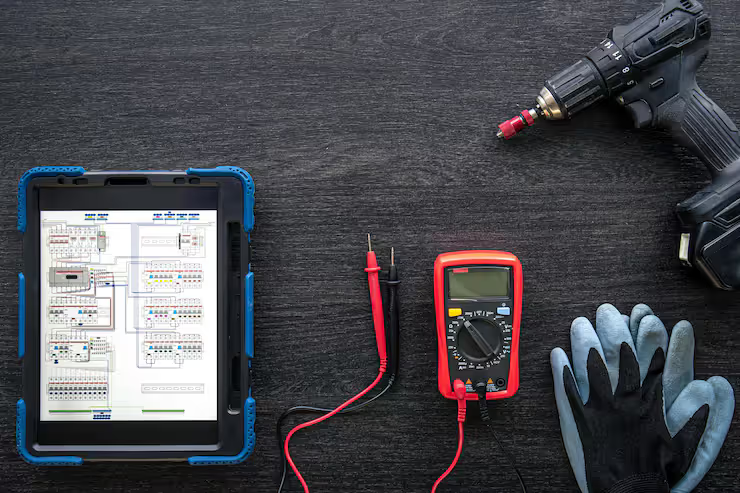
Thermal testing equipment plays a crucial role in analyzing how materials, components, and systems perform under varying temperature conditions. It helps engineers, manufacturers, and researchers understand the thermal stability, heat resistance, and durability of products before they reach the market. This process ensures safety, reliability, and efficiency across numerous industries, from electronics and energy to automotive and aerospace engineering.
Thermal testing equipment refers to instruments designed to measure and evaluate temperature-related characteristics of materials or devices. These tools are essential in determining how an object reacts to heat, cold, or rapid temperature shifts.
In industries like electronics and manufacturing, components must withstand fluctuating thermal conditions. For instance, semiconductors, batteries, and printed circuit boards are often tested under extreme temperatures to ensure stable performance. Similarly, construction materials and industrial machinery undergo thermal analysis to confirm they won’t degrade or malfunction under heat stress.
Thermal testing also supports research and development, helping scientists identify the ideal materials for high-performance applications. Without such testing, products could fail prematurely, leading to financial losses, safety risks, and reduced operational reliability.
Importance – Why Thermal Testing Matters Today
As industries push for higher performance and sustainability, understanding thermal behavior has become increasingly critical.
-
Product reliability: Thermal testing ensures that devices can operate safely within temperature limits, reducing the risk of overheating or thermal failure.
-
Energy efficiency: Analyzing how heat moves through materials allows manufacturers to design more energy-efficient systems, lowering power consumption and improving sustainability.
-
Material innovation: Researchers rely on thermal data to create new alloys, composites, and polymers that perform under extreme conditions.
-
Safety and compliance: Thermal testing helps meet regulatory and safety standards that protect both users and the environment.
Industries such as electronics, automotive, aerospace, renewable energy, and materials science depend on precise thermal analysis to maintain product integrity and quality assurance. For example, in battery technology, monitoring heat generation and dissipation prevents thermal runaway—a critical concern in electric vehicles and energy storage systems.
Recent Updates and Trends
The thermal testing landscape has evolved significantly in recent years due to advances in automation, artificial intelligence, and material science.
1. Smart and Automated Testing Systems (2024–2025)
Modern thermal testing equipment integrates automation and AI-driven data analysis to deliver faster, more accurate results. Automated systems reduce human error and enhance consistency, especially in large-scale manufacturing environments.
2. Rise of Sustainable Testing Solutions
In response to environmental goals, many laboratories have adopted energy-efficient testing methods. For instance, eco-friendly thermal chambers and low-power data acquisition systems are now standard in many facilities.
3. Miniaturization and Portable Test Devices
Compact, handheld thermal testers are increasingly popular for on-site diagnostics. These devices provide quick readings, reducing the need for bulky laboratory setups.
4. Integration with Simulation Software
Simulation and digital twin technology are now being used alongside physical testing. Engineers can replicate real-world temperature conditions digitally, then validate their results through physical tests, enhancing efficiency.
5. Global Industry Growth
According to recent industry reports from 2024, the global thermal analysis equipment market is projected to grow steadily due to increased demand for electronics, electric vehicles, and renewable energy systems.
These advancements reflect how thermal testing is adapting to the needs of modern manufacturing and environmental sustainability.
Laws and Regulations Affecting Thermal Testing
Thermal testing is governed by international and national standards to ensure safety, reliability, and quality consistency. Some of the most recognized frameworks include:
-
ASTM International Standards (U.S.) – Defines methods for thermal conductivity, diffusivity, and stability testing across various materials.
-
ISO 11357 Series (Global) – Covers differential scanning calorimetry (DSC), thermogravimetric analysis (TGA), and related procedures.
-
IEC 60068-2 (Electronics) – Specifies environmental testing for electronic equipment, including temperature and humidity resistance.
-
RoHS and REACH Regulations (Europe) – Indirectly influence thermal testing by ensuring material safety and environmental compliance.
-
BIS Standards (India) – Regulate industrial equipment testing for mechanical and thermal safety performance.
Compliance with these regulations ensures that testing procedures produce reliable, internationally accepted data. Manufacturers and laboratories must adhere to such standards to achieve certification and maintain quality assurance.
Tools and Resources
A wide variety of instruments, software, and digital platforms are available for conducting and analyzing thermal tests. Here are some widely used tools and resources in the field:
| Tool Type | Purpose | Examples |
|---|---|---|
| Thermal Chambers | Simulate controlled heating and cooling cycles | Environmental test chambers, climatic chambers |
| Infrared Cameras | Capture real-time temperature distributions | FLIR Systems, Testo thermal imagers |
| Thermal Analyzers | Measure changes in material properties under temperature variations | DSC, TGA, DMA instruments |
| Data Acquisition Systems | Collect and monitor real-time test data | NI LabVIEW, Keysight DAQ systems |
| Simulation Software | Model heat transfer and predict behavior | ANSYS Thermal Analysis, COMSOL Multiphysics |
| Calibration Tools | Maintain accuracy and consistency | Thermocouple calibrators, precision temperature baths |
In addition, several online platforms and organizations provide valuable educational materials:
-
ASTM Learning Portal – Offers certification and online modules on testing standards.
-
Engineering Toolbox – Includes free calculators for heat transfer, thermal conductivity, and insulation performance.
-
NIST Thermophysical Properties Database – Provides verified data for material testing and comparison.
-
ResearchGate and ScienceDirect – Contain peer-reviewed research on new testing techniques and findings.
Frequently Asked Questions
1. What is thermal testing used for?
Thermal testing determines how materials or systems respond to temperature changes, ensuring they can operate safely and efficiently in various conditions. It’s essential for industries that rely on thermal stability and heat management.
2. How is thermal testing performed?
Thermal testing typically involves exposing a sample or component to controlled temperature variations using specialized equipment like thermal chambers, heaters, or sensors while monitoring responses such as expansion, heat flow, or material degradation.
3. Which industries rely most on thermal testing?
Electronics, automotive, aerospace, energy, and materials science industries rely heavily on thermal testing to ensure product reliability, performance, and safety.
4. What parameters are measured during thermal testing?
Common parameters include thermal conductivity, thermal diffusivity, specific heat, and temperature stability. These metrics help evaluate a material’s ability to store or transfer heat.
5. How does thermal testing contribute to sustainability?
By identifying efficient materials and reducing energy loss, thermal testing supports the development of environmentally friendly products and processes, aligning with global sustainability goals.
Conclusion
Thermal testing equipment stands at the center of technological innovation, safety, and efficiency across modern industries. From ensuring the reliability of semiconductors and automotive components to advancing renewable energy systems, thermal testing enables a deeper understanding of how materials behave under real-world conditions.
As industries adopt automation, AI, and sustainable design principles, thermal testing will continue to evolve as a cornerstone of product research and development. With clear regulations, standardized tools, and accurate data analysis, it ensures the world’s most critical technologies perform safely and efficiently under any thermal environment.